




Frequency modulation (FM) audio synthesis
FM synthesis is designed to create more complex sounds by modulating one oscillator with another to generating new harmonics.
Introduction to FM synthesis
Frequency modulation synthesis is achieved when one oscillator modulates the frequency of another oscillator, such FM oscillators are usually called operators. Traditionally sine waves are used as they have the least amount of static harmonics that are often unwanted for this type of synthesis.
FM synthesis was firstly implemented in Boochla synthesisers in 1960, this type of synthesis became very popular in the 80s with release of digital Yamaha synthesizers that had digital FM synthesis with many operators and polyphony.
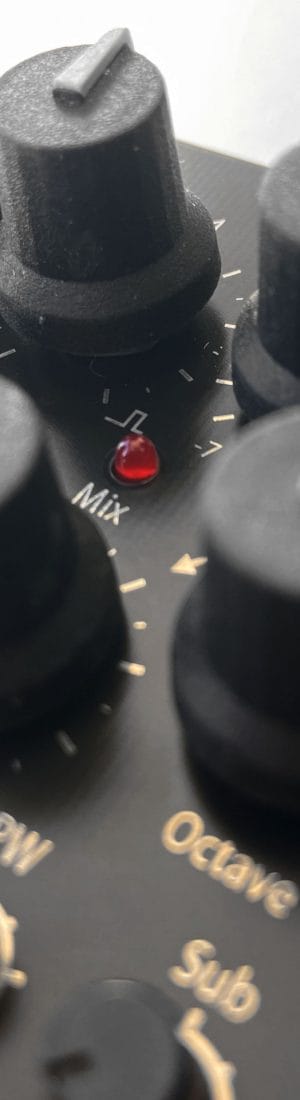
We have developed compact dual analog voltage controlled oscillator (VCO) Eurorack module that can patched for different types of FM synthesis with flexibility to do different types of FM at the same time.
Harmonic and inharmonic FM sounds
FM synthesis can generate very rich harmonic and inharmonic sounds. Its implementation is not as straight forward as subtractive synthesis opening the way to more experimentation and often leading to unexpected results.
To generate harmonic sounds there must be harmonic relation between the modulators, for example octave below, perfect 5th which corresponds to exact half of the frequency in between the octaves etc.
Inarmonic sounds are also interesting, they can be used to generate bells, glassy, woody, cybernetic and other interesting textures useful as percussive elements.
Exponential FM
1 volt/octave pitch inputs are exponential as note frequencies have exponential relation. Notes of each higher octave have double the frequency compared to the previous octave.
Any of the wave forms from one oscillator can be patched to exponential FM input to the second oscillator generating exponential FM.
Exponential FM is inharmonic because the relation of negative and positive CV swings generates uneven frequency relations changing the pitch.
Despide of being inharmonic – exponential FM has its uses when generating rhythmic sounds, it can produce all kinds of drums, hi-hats and other noises, also evolving pads and textures.
Linear and Through Zero FM
By definition linear FM modulates the frequency in linear way producing harmonic sound as negative and positive modulation swings have the same frequency relation. The problem with linear FM is that if the frequency gets to 0 hertz – the oscillators stops creating flat voltage.
Linear FM has been improved to Through Zero FM (TZFM) where frequencies below zero herz make the oscillator move backwards instead of stopping. This allows a wide range of interesting tones that sound harmonic to the ear.
When used both at the same time linear and exponential FM can create a wide range of percussive sounds where linear fm provides the texture and exponential FM controls how the pitch goes up and down mimicking drum membrane or metallic bell behaviour.
FM modulation index
Frequency modulation index refers to the volume of the modulating whaveform that is patched to the FM input of the second oscillator. Stronger waves affect the sound more creating more harmonics.
To vary the modulation index oscillator output is usually passed to the voltage controlled amplifier and then controlled with LFO or analog envelope. This creates changing FM sounds that can be very fast if we want to create rhythmic elements or slow for pads and sound textures.
Multiple FM operators
FM synthesis can get very complex with 5 or more separate modulators and modulation indexes controlled by separate envelopes.
Due to large resources needed complex FM is often implemented digitally such as Yamaha DX range of synthesizers. We are not big fans of digital FM as they tend to create very cheesy sounds often unsuitable for the music we create.
Filters in FM synthesis
Analog filter has much less effect in FM synthesis. It can still be used to trim the annoying high frequency overtones but the resonance will have much less effect compared to subtractive synthesis.
One advantage of this is that instead of patched to the filter – the control voltage can be used in different parameters such as varying pitch relation between the operators.